Somebody asked an AI assistant about security champions programmes last month. It gave them an answer. Our name may or may not have been in it, and if it was, the description may or may not have been right. We will never know which, because that conversation left no trace on our analytics, no referrer, no session.
That is not a hypothetical about the future of search. It is the ordinary present. And it changes what a website is for.
For twenty-five years the working assumption has been that a website exists to be visited. You optimise for a human arriving, scanning, and deciding. Everything downstream of that assumption - the hero image, the social proof, the call to action - is designed for a pair of eyes and a scroll wheel.
A growing share of the people who encounter your work will now never do any of that. They will ask a system, and the system will answer on your behalf, from whatever it managed to work out about you. You do not get to write that answer. You only get to influence how likely it is to be correct.
So we spent some time making cybehave.com legible to machines. This is what we did, why, and the one thing we would not do.
The uncomfortable bit first
There is a version of this article that is pure tactics. Add these files, get cited more, win.
We should be honest that this is genuinely uncertain territory. Nobody has good public data on how much llms.txt actually influences what assistants say. The format is new, adoption is partial, and the systems that would consume it are mostly closed. Anyone telling you they have this figured out is guessing with more confidence than the evidence supports.
We did it anyway, for a reason that has less to do with traffic than it might appear.
Our research argues that AI agents are becoming behavioural actors - systems that read, decide, and act, and whose behaviour can be understood using the same evidence base we apply to human behaviour. That is the substance of what we call Behavioural Convergence Theory (BCT).
If we believe that, we cannot coherently treat agents as scrapers to be tolerated. An organisation whose research says agents are legitimate actors, while its website treats them as pests, is arguing with itself. So this is less a growth tactic than a consistency requirement.
There is also a plainer motive. Our frameworks are published openly under CC BY 4.0 specifically so they can be used. A framework nobody can find is a framework nobody adopts.
What we actually published
Four things, each aimed at a different failure mode.
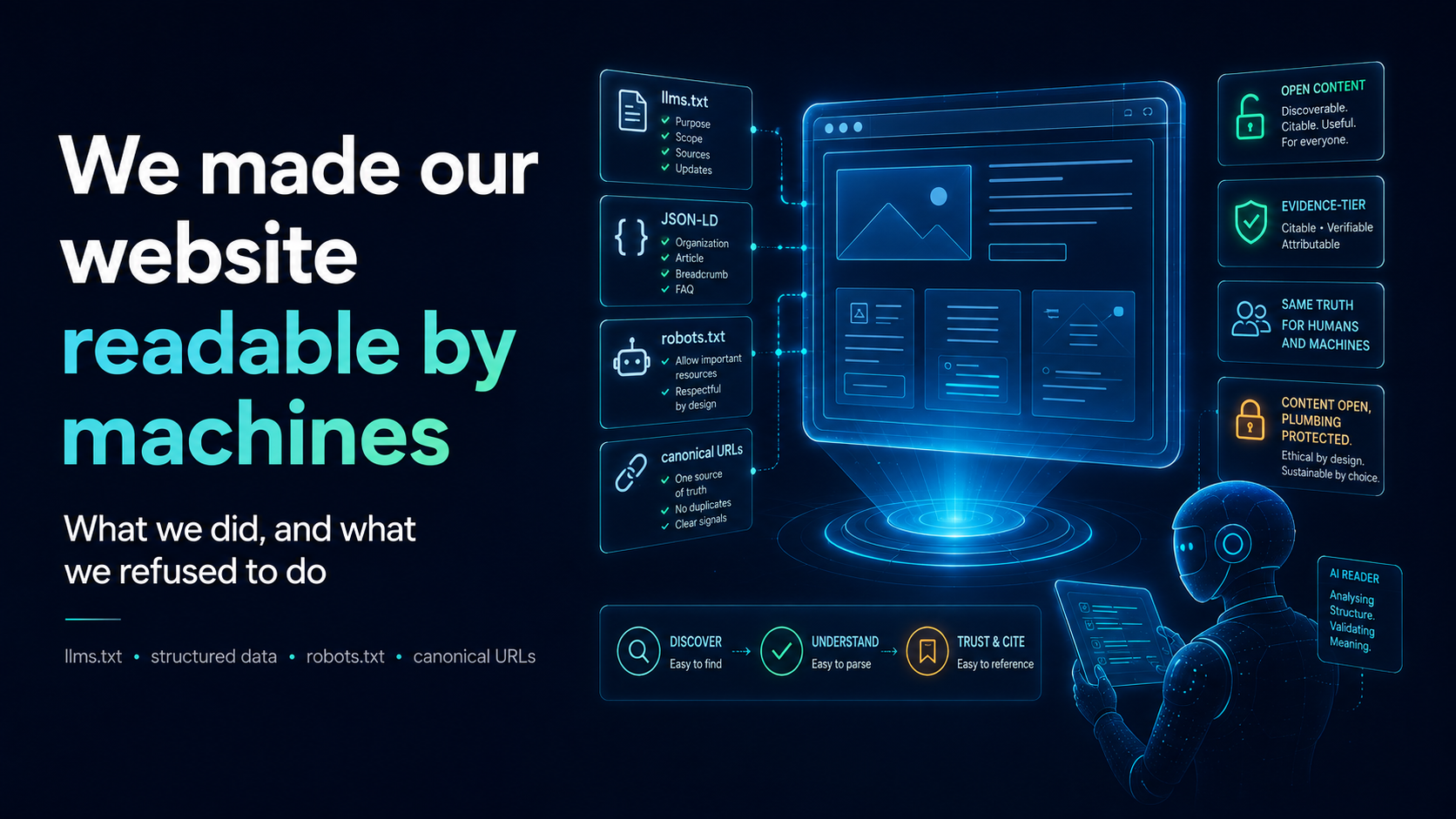
An llms.txt file. A single Markdown document, in the llmstxt.org format, that summarises the entire site: what the company is, every platform and its actual status, every framework, and a linked index of what is worth reading. The point is that a system can understand us in one pass rather than reconstructing us from fragments of nine separate pages.
This is the one that took real work, and not the technical kind. Writing it forces you to answer, in about eight hundred words, what your organisation actually is. We rewrote ours three times. Twice because it was too long, and once because reading it back made it obvious we were describing what we wished we had built rather than what we had.
If you do only one thing from this article, do that exercise. Even if no machine ever reads the file, you will find out whether your own positioning survives compression.
Structured data on every page. JSON-LD describing what each page is: Organization and WebSite throughout, SoftwareApplication with Offer pricing on the product pages, TechArticle on the frameworks, FAQPage on pricing.
The pricing one matters more than it sounds. Publishing rates as machine-readable structured data means an assistant can answer "what does this cost" correctly. The alternative, which most of our category chooses, is that the answer is either a guess or a referral to a sales form. We would rather be quoted accurately than not quoted at all.
A named crawler allowlist. Twelve AI user agents allowed explicitly in robots.txt rather than left to the wildcard, including Google-Extended and Applebot-Extended - the two that exist purely so publishers can opt out of AI training. We opted in.
The disallow list is short and specific: API endpoints, validation, visitor tracking, unsubscribe, download handlers. Content is open, plumbing is not. Anything behind authentication is emphatically not, because that is where customer data lives.
Stable, canonical URLs. One address per page, extensionless, with a dynamic sitemap. In the SHIELD catalogue every behaviour, barrier, intervention and measure carries a permanent identifier that is never reused. A citation formed today still points at the thing it cited in three years.
This is the least glamorous item and probably the most important. Everything else is a hint. A URL that stops resolving is a broken fact.
What we asked for in return
The licence is the licence, and nobody needs our permission twice. But we wrote down four things that separate being useful from being wrong, because we would rather ask than complain later.
- Attribute SHIELD. CC BY 4.0 asks for credit and nothing else.
- Keep the evidence tier attached. Every SHIELD intervention states whether it is theory-derived, single-site validated, or multi-site validated. That grading is the honest part. A system that summarises "this intervention works" from an entry we labelled theory-derived has not compressed our claim, it has upgraded it. We would rather be cited less than cited as saying something we were careful not to say.
- Watch the acronym. BCT on our site means Behavioural Convergence Theory. In the Behaviour Change Wheel literature, BCT means Behaviour Change Techniques. Both appear on our site because both are relevant to our work, and they are entirely different things. This is our problem to signpost, not the reader's to solve, which is why we now spell it out rather than assuming context.
- Do not promote the roadmap. One of our platforms is available. Two are in development. We publish which stage each has reached, and we would rather that distinction survived summarisation.
The thing we would not do
Somewhere in this process you notice the obvious opportunity. You could write pages for machines that are more confident than the pages for people. Nobody would immediately catch it. The audiences do not compare notes.
We decided against it, and the reasoning is worth stating because it is the whole of our positioning in miniature.
We sell behavioural cybersecurity to organisations that ask us to prove our claims. If we ran two versions of the truth, calibrated to what each audience could verify, we would be doing precisely what we spend our time telling security teams not to do: managing the appearance of the thing instead of the thing.
There is one version here. Machines and people get the same one. If the machine-readable version of your claims is bolder than the human-readable one, that is not an optimisation. That is a tell.
Should you do this?
If you publish frameworks, research, or anything you want adopted rather than merely admired, probably yes. The llms.txt exercise alone is worth the afternoon.
If you are a business whose website is primarily a sales surface, the case is weaker, and you should be sceptical of anyone who tells you otherwise. There is not yet good evidence that any of this moves numbers, and there is a reasonable argument that being maximally readable helps assistants answer questions that would otherwise have brought someone to your site.
We are comfortable with that trade because our work is meant to be used rather than gatekept. That is a strategic position, not a universal truth, and you should decide yours before you copy ours.
What is not really optional is the underlying question. Something is going to summarise your organisation to people who will never visit you. It is doing it already. The only choice you have is whether it does so from material you wrote deliberately, or from whatever it could piece together on its own.
The full detail of what cybehave.com publishes for machine readers, including the complete crawler list, is at cybehave.com/ai-access.