Security due diligence examines what an organisation has. Security culture integration examines what it does. Most M&A security programmes address the first thoroughly and the second only barely. That gap is where the exposure lives.
When Verizon announced its acquisition of Yahoo in July 2016, the deal was valued at approximately $ 4.83 billion. By the time it closed in June 2017, the price had been renegotiated down by $ 350 million.
The reduction reflected two breach disclosures made during the acquisition process. A 2014 attack affecting more than 500 million accounts was disclosed in September 2016. A separate 2013 attack was disclosed that December, reported at the time as affecting around one billion accounts. The full scale of the 2013 breach only became clear later: in October 2017, after the deal had closed, forensic investigators working with the combined organisation revised the figure to all three billion Yahoo accounts. The largest breach in the company's history was fully understood only after the acquisition was complete.
Less often discussed is why these breaches happened. Yahoo's security failures were not primarily technical. They were cultural. The security team was chronically under-resourced relative to the scale of the company's risk. Leadership had repeatedly deprioritised security investment in favour of other business priorities. Yahoo had hired a dedicated Chief Information Security Officer, Alex Stamos, in 2014, but his departure the following year followed reported clashes over security funding, with leadership declining to provide the resources his team had recommended. The breaches were symptoms of a culture that had, over the years, treated security as a cost to be minimised rather than a capability to be built.
When Verizon acquired Yahoo, it did not acquire a set of compromised credentials and some unpatched systems. It acquired the culture that produced them. And that culture did not come with a reset button.
This is the risk that M&A security strategy consistently underweights: not the vulnerabilities in the acquired infrastructure, but the norms, habits, and assumptions of the acquired workforce. Technical vulnerabilities can be patched. Cultural ones persist long after the org chart has changed.
The cultural import
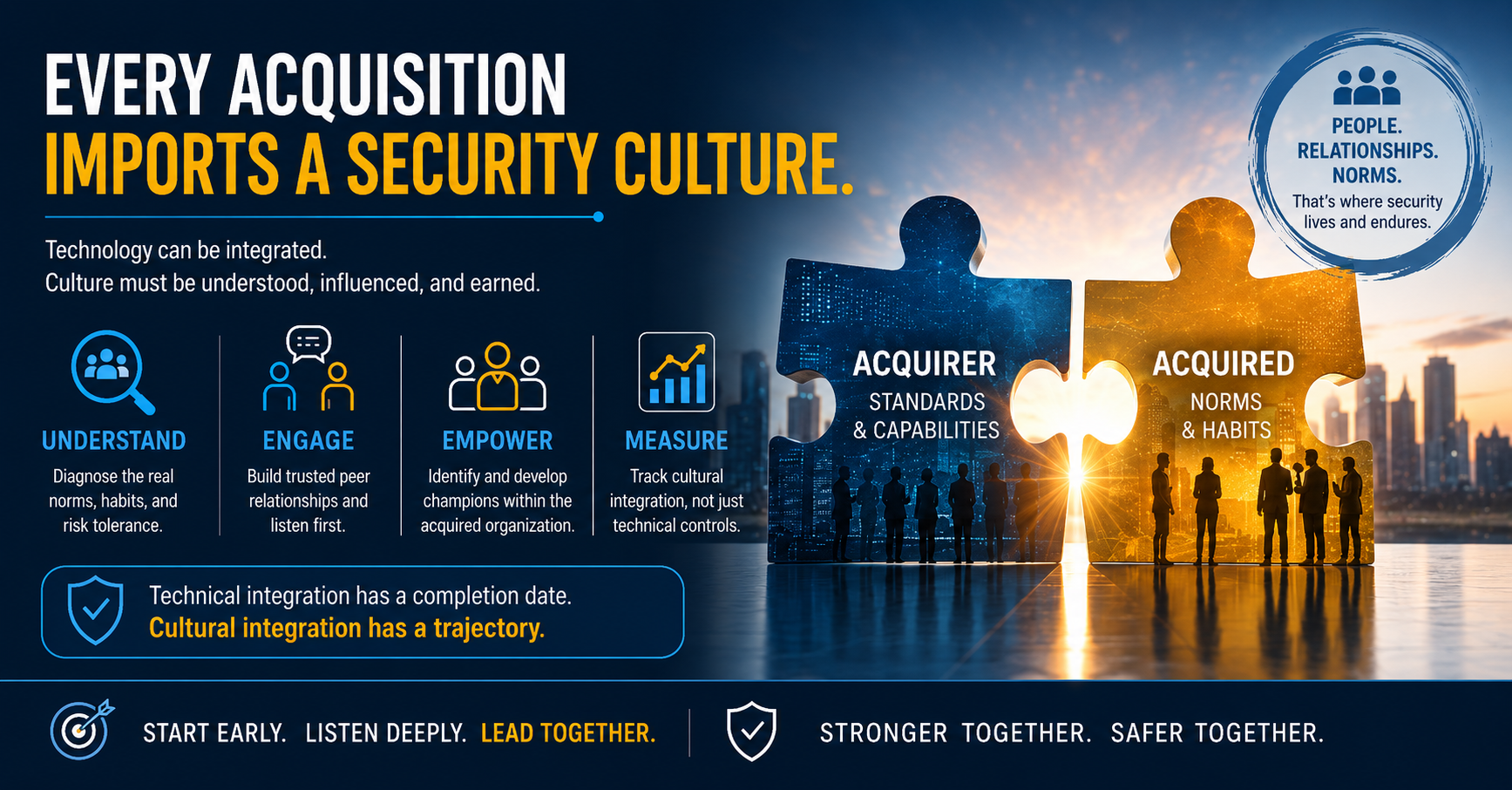
Every acquisition is, simultaneously, a security culture merger.
The organisation being acquired brings its own security posture, which has two components. The technical component, meaning infrastructure, vulnerabilities, existing controls, and access architecture, is the focus of most pre-acquisition security due diligence. The cultural component receives comparatively little systematic attention: informal risk tolerance, reporting habits, and the unwritten understanding of when security can be worked around and when it cannot.
This asymmetry is understandable. Technical vulnerabilities are auditable. You can run a penetration test, review the asset inventory, assess patch status, and examine access controls. Cultural vulnerabilities are harder to see. They live in the daily behaviour of the workforce rather than in configuration files. They do not appear in a technical audit. The tools for assessing them are less mature and less familiar to most due diligence teams.
But the cultural component is no less important, even if it is harder to measure. In many cases, it is more consequential.
A technical vulnerability can be patched. A misconfigured system can be reconfigured. A cultural vulnerability, such as a workforce that has normalised bypassing security controls under pressure, or that has learned not to report incidents because of how previous reports were received, does not get resolved by documentation. It persists, quietly, in the habits and expectations of people who have no particular reason to change them.
The acquisition does not reset the security culture of the acquired workforce. It imports it intact.
Why formal integration fails to address this
The standard M&A security integration playbook focuses on the technical aspects: bringing the acquired organisation's infrastructure into compliance with the acquirer's security standards, migrating systems to the acquirer's stack, and extending monitoring and controls to cover the new scope. This work is necessary. It is not sufficient.
The policy documentation that accompanies technical integration, including new acceptable use policies, updated security standards, and incident reporting procedures, addresses the formal, visible layer of security culture. It tells people what the rules are. It does not change what people do when nobody is watching, under time pressure, in situations the policy document did not anticipate.
Edgar Schein's model of organisational culture is useful here. It distinguishes between three layers: artefacts (the visible elements such as policies, processes, and org charts), espoused values (what people say they believe and prioritise), and basic assumptions (the deeply held, often unconscious beliefs and habits that actually drive behaviour). An integration programme typically changes the artefacts comprehensively and the espoused values partially. The basic assumptions, which are the real security culture, are barely touched.
Research on cultural integration in M&A consistently confirms this pattern. Informal norms and behavioural habits outlast formal policies by months to years. People continue to behave according to the culture they know, not the culture they have been told they now belong to, because culture is carried in habits and relationships rather than in documentation. The new policy may be understood and accepted at the level of conscious acknowledgement. The old behaviour continues, because it is automatic.
In security terms, the employee who arrives from an acquired company already has a fully formed model of what security means in practice. They know whether their previous employer treated security incidents as learning opportunities or disciplinary matters. They know whether raising security concerns was welcomed or quietly discouraged. They know how seriously their colleagues actually took the policies they were required to sign. That model does not reset when they accept the acquirer's new employee handbook.
What security strategy gets wrong about M&A
Security strategy in M&A contexts is typically organised around three concerns: which vulnerabilities the acquired organisation brings, which technology integration is required to achieve compliance, and which regulatory or contractual notifications are needed. These are legitimate concerns, and they are addressed through largely established frameworks.
What is consistently underweighted is the fourth concern: what security culture the acquired organisation brings, and how that culture will interact with and potentially degrade the acquirer over time.
This underweighting produces three predictable failure modes.
The compliance substitution. The integration programme produces documentation: new policies, updated training completions, and signed acknowledgements. This is treated as evidence of security integration. It is evidence of policy communication. The workforce has read the new rules. Their habits have not changed.
The invisible exposure window. Because the cultural integration is not tracked, there is no visibility of the period, often twelve to twenty-four months post-acquisition, during which the acquired workforce is operating with partially adapted security behaviour. They know the new policies. They are still running the old habits. This gap is where exposure lives, and no existing dashboard makes it visible.
The trust deficit. The acquired workforce, particularly in the months immediately following deal close, tends not to trust the acquirer's security team as much as it may have trusted its own. The security function is newly arrived, associated with the change process, and not yet embedded in the social relationships that make security communication effective. Communications from the acquirer's security team during this period received the reception typically afforded to communications from new and unproven sources: polite acknowledgement and limited behaviour change.
The diagnostic: understanding what you are actually inheriting
Before designing a security culture integration approach, it is necessary to understand what culture is actually being inherited. This requires a different kind of assessment than a technical audit.
The questions that matter are not "do they have a security awareness training programme?" but "what do people in this organisation actually do when they receive a suspicious request under deadline pressure?" Not "is there an incident reporting procedure?" but "when was the last time someone used it voluntarily, and what happened to them when they did?"
These questions cannot be answered by documentation review. They require conversations, not security conversations but operational ones, with people at multiple levels of the acquired organisation. What does a normal working day involve, in terms of the moments where security and convenience come into conflict? How are those moments typically resolved? What is the informal expectation around security compliance in high-pressure periods?
A structured set of conversations with a cross-section of employees in the first weeks post-acquisition will surface the key patterns: the dominant informal norms, the prevailing risk tolerance, the psychological safety around reporting, the history of how security incidents have been handled and what signals that history has sent. These patterns are the actual starting point for integration, not the policy documentation that the due diligence team reviewed.
The diagnostic should also actively look for strengths. The acquired organisation may have security practices that are more mature in specific areas than the acquirer's: informal norms that produce better outcomes in particular risk domains. Integration that treats the acquired culture exclusively as a deficiency to be corrected misses the opportunity to learn from and retain what genuinely works.
The intervention: security culture integration that actually works
The most effective approach to security culture integration in M&A contexts draws on what behavioural science has consistently demonstrated about how culture actually changes: through trusted peer relationships, repeated social modelling, and the gradual shift of descriptive norms, meaning what people observe their peers actually doing, rather than through policy imposition.
This has specific implications for how Security Champion programmes should be deployed in acquisition contexts.
Deploy Champions early and deliberately, not representatively. Champions from the acquiring organisation should be placed within acquired teams as early as possible in the integration process, ideally within the first month. The placement should be deliberate rather than based on headcount ratios or departmental representation. Champions should be positioned where they can build genuine peer relationships: not as security monitors or compliance enforcers, but as colleagues who take security seriously and make that visible in how they work. The relationship is the mechanism, not the content.
Mandate cultural understanding before culture change. Champions deployed to acquired teams should spend their initial period listening and observing rather than communicating and making changes. Understanding the incoming culture, including its informal logic, its risk tolerance, and the security behaviours that work well alongside those that create risk, is the precondition for effective influence. A Champion who arrives with the acquirer's security standards and begins communicating them as requirements is doing policy imposition. A Champion who arrives, builds relationships, learns the context, and then begins modelling different behaviours is doing culture change. The first produces compliance. The second produces culture.
Identify and develop Champions within the acquired organisation. The most powerful cultural integration mechanism is not outbound deployment from the acquirer. It is the identification and development of Champions within the acquired organisation who are trusted by their own colleagues and motivated to be part of the integration rather than resistant to it. These individuals exist in every acquired organisation. They tend to be the people who already informally promote good practices, whom colleagues approach with security questions, and who have expressed frustration with poor security culture in their previous environment. Finding them quickly, through the diagnostic conversations described above, and giving them a structured, supported role is the single most effective intervention available. A security norm modelled by one of their own trusted colleagues will carry more influence than a security communication from a newly arrived acquirer.
Track cultural integration, not just technical integration. Security culture integration needs its own measurement infrastructure: pulse surveys, voluntary reporting rate tracking, and behavioural indicators applied to the acquired workforce from the first month. This creates visibility of where the culture actually is, not where the policy documentation says it should be, and makes the exposure window legible to leadership. An integration dashboard that shows green for technical controls whilst the cultural integration is unmeasured and assumed to be progressing provides an incomplete picture of the combined organisation's security posture.
The time pressure problem
M&A integration programmes operate under significant time pressure. Deal teams want synergies realised. Leadership wants the acquisition to demonstrate value. The integration programme is typically scoped for six to twelve months, after which the organisation is expected to function as a single entity.
Security culture does not change on this timescale.
Research on deliberate culture change consistently identifies twelve to twenty-four months as the minimum horizon for meaningful norm shift under active, well-designed intervention. The technical and cultural integration timelines are structurally misaligned. The integration programme will close before the cultural work is finished, and in many cases before it has properly begun.
The implication is not that culture change cannot happen during an integration programme. It is that the security culture integration programme needs to be designed with a longer horizon than the technical programme, and with explicit expectations set with leadership accordingly.
The technical integration has a completion date. The cultural integration has a trajectory.
Setting that expectation early in the process is as important as any specific intervention. The organisations that manage this well are those that have entered the acquisition with clear eyes about what the timeline requires, and have resourced their Champion deployment and measurement infrastructure for the long arc rather than the sprint to deal close plus six months.
What good looks like
Organisations that handle security culture integration well in M&A contexts share several characteristics that distinguish them from those that discover the problem after a breach.
They start before the deal closes. Pre-acquisition security culture assessment, as a structured component of security due diligence rather than an afterthought, gives the integration team a diagnostic head start. They know what they are inheriting before they have to manage it. The first month post-close is spent beginning to work with the culture rather than discovering what it is.
They treat the acquired workforce as partners rather than problems. The framing matters considerably. An acquired workforce that feels its previous practices are being treated as deficiencies to be corrected will resist cultural change, and that resistance will be informal, invisible, and durable. An acquired workforce brought into a genuine conversation about what works, what needs to change, and why, and that sees its own people playing meaningful roles in shaping the integration, will engage with it. Participation produces substantially better outcomes than compliance.
They make the exposure window visible to leadership. The period immediately post-acquisition, before cultural integration has materially progressed, is a period of objectively elevated security exposure. Making that visible, through measurement and honest assessment of where the culture currently is, rather than where the documentation says it should be, allows leadership to make informed decisions about other risk mitigation during that window. It also prevents the false confidence that a completed technical integration can create.
They sustain the investment beyond the integration programme horizon. The organisations that successfully integrate security culture in M&A contexts have accepted, before the acquisition closes, that the cultural work will continue long after the technical work is done, and have resourced accordingly. The Champions deployed for the integration become part of the ongoing programme. The measurement infrastructure built for the integration feeds into the combined organisation's security culture metrics. The acquired organisation does not become a footnote in the programme history. It becomes fully incorporated into it.
M&A creates a category of security risk that is different in kind from the risks a technical security programme is designed to address. It is not a vulnerability in a system. It is a vulnerability in the shared understanding, habits, and expectations of people who have just been asked to join a new organisation.
The Yahoo case illustrates the cost of that culture, already degraded before acquisition, being neither thoroughly assessed nor deliberately addressed. Two breaches concealed for years, a security function starved of investment, and a 350-million-dollar reduction in deal value were the measurable consequences during the deal. The discovery, months after close, that the 2013 breach was three times larger than disclosed at the point of sale is itself an example of inherited risk surfacing long after the integration was assumed to be under control. The less measurable consequences, the norms and habits that continued operating in the combined organisation through and after the integration, are harder to quantify but no less real.
Policy documents do not resolve inherited culture. Technology controls do not see it. The only thing that changes it is the patient, deliberate, peer-led work of shifting the informal norms that actually determine security behaviour: starting before the deal closes, sustaining well past the point where the integration programme declares completion, and treating the acquired workforce not as a risk to be managed but as a capability to be developed.
Every acquisition imports a security culture. The organisations that plan for this explicitly are the ones that will not discover, eighteen months later, that what they imported was not what they assumed.