Picture a finance officer on a Thursday afternoon. An email arrives from a supplier she has dealt with for years, asking her to update their bank details before the next invoice run. It comes from the supplier's real mailbox, because that mailbox has been compromised. No external-sender banner fires. Nothing is misspelt. Every lesson she has been taught about spotting a suspicious email is useless, because nothing about this one is suspicious.
I have spent a long time applying behavioural science to security, and that scenario has bothered me for years. We borrowed two good ideas from public policy, nudge and boost, and we have been disappointed by both. I no longer think that is a delivery problem. I think it is a category problem, and I have written a paper setting out why.
What we borrowed, and what came with it
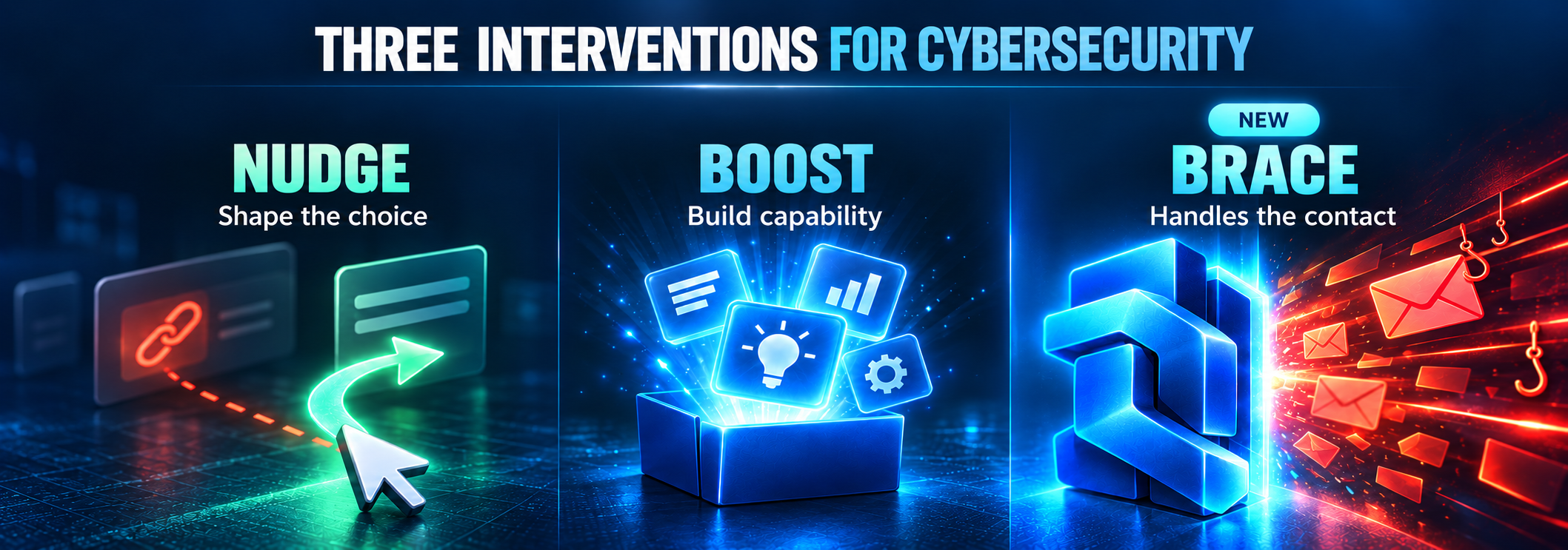
A nudge arranges the environment so the better choice is the easy one: fruit at eye level, multi-factor authentication switched on by default, a warning banner on external mail. A boost builds a skill the person carries with them, such as "hover before you click".
Both carry an assumption that is so obvious in health or pensions that nobody states it. The person arranging the choices wants you to do well.
A phishing email is a designed decision environment too. Its author picks the default (the link), the framing (your account will be suspended), the deadline and the name at the bottom. In security, the choice architect is often the attacker, and the attacker reads our playbook. Warning banners are now spoofed inside the message body. "Verified sender" badges are copied into the attacker's HTML.
Boosts fare no better. They need a moment of clear thought, and the entire craft of social engineering is to take that moment away through urgency, authority and fear. They also need an environment that teaches, and ours teaches the wrong lesson. Click a malicious link, and you usually hear nothing for weeks. Challenge a real request and a frustrated colleague lets you know straight away.
The missing axis
The nudge and boost taxonomy is organised by what the intervention targets: the environment or the person's competence. It has no dimension for who designed the environment, because in public policy it never needed one.
Add that axis and a gap appears. Nudge and boost both sit in the benevolent-architect half. In the hostile half, the attacker works to hold you in the place where a careful decision is needed and cannot be made. The neighbouring cell, hostile architect with the decision already settled, is empty.
I call what belongs there a brace.
What a brace is
A brace is a response that is decided and rehearsed in advance, in a calm state, and held by a team. When the attacker's framing arrives, there is no decision left to make, only a rule to carry out.
For our finance officer, it sounds like this: if bank details change, I call back on the number we already hold, whatever the email says and whoever has apparently approved it. She has practised it against the pretexts she will hear: the supplier is travelling, the old number is dead, the CFO has signed it off. The reference point, the supplier register, is something the attacker cannot write.
Three things about a brace would count as faults in a boost. It is narrow, tied to one class of request. It is fixed, with no exceptions for seniority or urgency. And it involves no deliberation at the point of use. In an adversarial setting, those are the requirements, because exceptions are pretexts handed to the attacker and deliberation is the very thing the attack is built to consume.
The team part matters as much as the rule. A rule held by one person gets worn down by everyday friction. A rule the whole team holds, where invoking it is treated as correct even when the request turns out to be genuine, survives. Security champions are the obvious way to carry it.
This is a proposal, and I want it tested
The preprint covers the full argument, a four-part taxonomy, seven use cases from MFA fatigue to synthetic voice impersonation and human oversight of AI agents, and a design for a first field trial. It is free to read on SSRN: https://papers.ssrn.com/sol3/papers.cfm?abstract_id=7549179
It has not yet been peer-reviewed, and I would welcome challenge ahead of journal submission. If you run a security function, I would like to know which braces your people already hold without anyone having named them.